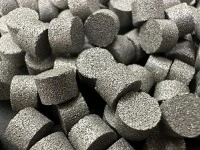

Titanium alloy is silvery white and shiny, ranking 22 in the periodic table, and its own chemical properties are very lively. If you want to melt titanium, you need a high temperature of 1 662 degrees Celsius, titanium is a group of high melting point metals in the light gold domain, with high hardness, tensile strength of 1 800 n/mm2, and strong plasticity. Titanium has a density of 4.54 g/cc. At room temperature, titanium is a close-packed hexagonal phase with a low temperature. At 885 ° C, titanium transitions into a body-centered cubic phase.
According to the properties, titanium alloys can be divided into corrosion-resistant titanium alloys, heat-resistant titanium alloys, low-temperature titanium alloys, and high-strength titanium alloys, among which high-strength titanium alloys are classified into high strength titanium alloys, high strength and high-temperature titanium alloys and high strength steel titanium alloys.
Titanium and titanium alloys have high strength and specific strength, good corrosion resistance, and high and low-temperature performance; Titanium and titanium alloys are not magnetic, in a strong magnetic field will not be magnetized; Some titanium alloys have some special properties, such as Ti2Ni alloy is a good shape memory material, and Nb2Ti alloy is a good low-temperature superconducting material.
Titanium and titanium alloys have been widely used in the fields of the aerospace industry, petroleum, chemical T., metallurgy, biological medicine, sports goods, etc., and have become an indispensable metal material for new technology, new technology, and new equipment.
1, High strength, the density of titanium alloy is generally about 4.51g/ cubic centimeter, only 60% of steel, the density of pure titanium is close to the density of ordinary steel, some high strength titanium alloy exceeds the strength of many alloy structural steel.
2, High thermal strength, the use of temperature is several hundred degrees higher than aluminum alloy, at moderate temperature can still maintain the required strength, can work in 450 ~ 500℃ temperature for a long time these two kinds of titanium alloy in the range of 150℃ ~ 500℃ still has high specific strength, and aluminum alloy at 150℃ than the strength decreased significantly. The working temperature of titanium alloy can reach 500℃, and that of aluminum alloy is below 200℃.
3, Good corrosion resistance, titanium alloy works in the humid atmosphere and seawater medium, its corrosion resistance is far better than stainless steel; Resistance to pitting corrosion, acid corrosion, and stress corrosion is particularly strong; Excellent corrosion resistance to alkali, chloride, chlorine organic articles, nitric acid, sulfuric acid and so on. But titanium has poor corrosion resistance to reducing oxygen and chromite medium.
4, Low-temperature performance is good, titanium alloy at low temperature and ultra-low temperature can still maintain its mechanical properties. Titanium alloys with good low-temperature performance and very low clearance elements, such as TA7, can maintain certain plasticity at -253℃. Therefore, titanium alloy is also an important low-temperature structural material.
5, Chemical activity, chemical activity of titanium is large, and the atmosphere O, N, H, CO, CO2, water vapor, ammonia, and other strong chemical reaction.
6, The thermal conductivity of small, the thermal conductivity of titanium λ=15.24W/ (m.K) is about 1/4 of nickel, 1/5 of iron, 1/14 of aluminum, and the thermal conductivity of various titanium alloys than the thermal conductivity of titanium decreased about 50%.
Contact:
If you have any questions, please feel free to contact us. Working hours: 8:30 a.m. to 17:30 p.m.
E-mail: zhangjixia@bjygti.com