

Porous titanium rods are a core functional material for precision filtration, fluid purification and industrial separation. They offer a uniform and controllable pore structure, corrosion resistance, high temperature resistance, high strength, and repeated regeneration. Engineers use them in chemicals, environmental protection, pharma, water treatment and new energy fluid filtration. Porosity is the most important technical index. It sets the flow performance, the filtration accuracy, the adsorption capacity and the structural stability. So it drives product selection, process design and application matching.
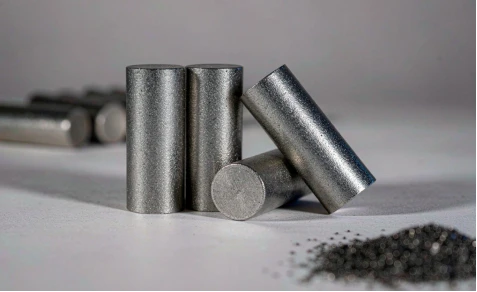
Sintered porous titanium rods with raw titanium powder
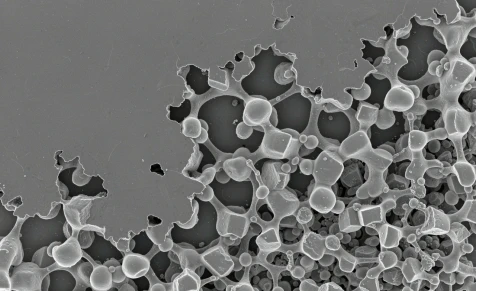
Micro pore structure of sintered porous titanium (SEM style)
What Porosity Means?

Cross-section of a porous titanium rod.
The split between pore volume and solid skeleton sets the 28%-50% industrial porosity range
Porosity is the share of void volume inside a porous titanium rod. We use it to describe how much of the material is open space. We also use it to judge how loose or dense the structure is. Engineers look at this number first when they select a filter.
Industrial sintered titanium filter rods usually hold porosity in the 28%–50% range. This range balances flow and strength well. So it has become the most mature and widely used window in industry.
Higher porosity means more void space and less solid skeleton. Lower porosity means a denser structure and higher stiffness. Neither direction is always better. Engineers pick based on the working conditions.
Porosity and Pore Size Are Two Separate Parameters
 Two porous titanium samples with the same porosity. Left: many small pores. Right: few large pores
Many engineers mix up porosity and pore size. But they are two separate parameters.
Porosity tells you how many pores there are. Pore size tells you how big they are.
Two porous titanium plates can share the same porosity and still differ a lot in pore size. One has few large pores. The other has many small pores. Their filtration behavior is completely different.
A material with many small pores filters fine. But it creates a high pressure drop. A material with few large pores flows fast. But it cannot hold back fine particles. So engineers must read porosity and pore size together. Two media with the same porosity but a different pore size distribution perform differently.
How Porosity Affects Filtration Performance?
Porosity drives the surface area, the flow rate and the particle capture of a filter. So it is a core factor for filtration efficiency.
Inside a reasonable process window, a high-porosity rod has more effective surface area. It offers more adsorption sites and more flow channels. When fluid passes, the material catches suspended solids, fine particles, colloids and microbes. So cleaning works better.
A uniform pore structure helps in one more way. It cuts flow resistance while keeping filtration accuracy. So the material reaches both high accuracy and high flux. It also avoids clogging, stagnation and a large pressure drop. That makes it a good fit for continuous, high-volume filtration.
Porosity and Pressure Drop: Darcy and Kozeny–Carman
Engineers can use Darcy's law to understand pressure drop in a simple way. Darcy's law says flow rate rises with pressure drop and with permeability. Higher permeability means fluid passes more easily.
The Kozeny–Carman equation also includes porosity. This equation tells us that higher porosity lowers flow resistance. The reason is simple. More void space means more paths for the fluid.
But there is a catch. Flow resistance also depends on pore size and thickness. Smaller pores raise resistance. A thicker part raises resistance. So porosity is not the only variable. Engineers should not judge from porosity alone.
Capture Mechanisms: More Than One
Porous titanium captures particles in more than one way. We usually split it into a few mechanisms.
Surface filtration happens at the surface. Large particles stay outside and form a filter cake. Depth filtration happens inside the material. Small particles enter the pores and stick to the pore walls.
Screening is the most direct effect. Particles larger than the pore cannot pass. Adsorption relies on active sites on the titanium surface. Diffusion and inertial impaction matter more for gases and fine particles.
These mechanisms often work at the same time. Engineers predict which one dominates from particle size and flow state.
The Trade-off Between Porosity and Mechanical Strength
Porosity and mechanical performance trade off against each other. This is the core conflict in making and using porous titanium.
As porosity rises, the solid metal skeleton shrinks and the structure becomes less dense. Compressive strength, bending strength and structural stability all drop. Too much porosity leaves the material with low toughness and weak load capacity. Under high pressure, pulse backwash or cyclic load, the structure may deform and the pores may collapse.
Low porosity gives a dense structure and high mechanical strength. It resists impact and high pressure, and it lasts longer. But it has fewer flow channels and less surface area. So flux drops and flow resistance rises.
Here is the key point. Strength does not fall in a straight line as porosity rises. Each extra point of porosity cuts strength faster than the last one does. So engineers cannot estimate strength by a simple proportion.
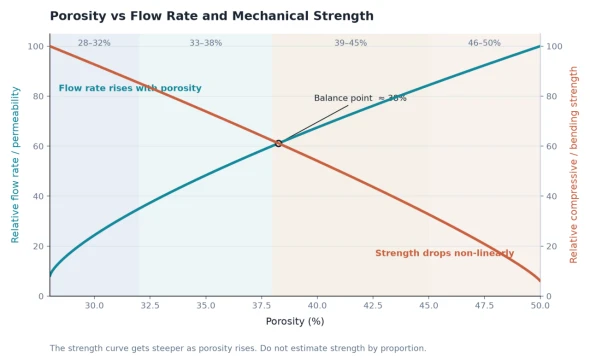
Porosity vs flow rate and mechanical strength. Strength drops non-linearly while flow keeps rising. Balance point near 38%
Fatigue and Backwash Life
Backwash is the most common way to regenerate a titanium filter. But each backwash adds one stress cycle to the skeleton. A high-porosity material has thin struts and a short fatigue life. A low-porosity material has thick struts and survives more backwash cycles.
So for frequent backwash, engineers should lower the porosity.
How We Measure Porosity?
We use four common methods to measure porosity in porous titanium. Each one fits a different case.
Archimedes Method
The Archimedes method is the most basic one. We soak the sample in water until it is fully wet. Then we compare the dry weight and the wet weight. This method works well for open-cell rods with a regular shape. It is cheap and fast. But it does not see closed pores, so it misses their volume.
Mercury Intrusion Porosimetry (MIP)
Mercury intrusion porosimetry goes finer. We push mercury into the pores under high pressure. Pores that mercury cannot enter stay uncounted. This method gives both porosity and pore size distribution. So it fits porous titanium with nano-scale to micron-scale pores.
Gas Adsorption (BET)
Gas adsorption mainly measures surface area. We let nitrogen adsorb onto the surface at low temperature. This method is sensitive to nano-scale pores. We often use it for titanium getters and ultra-fine pore materials.
Image Analysis
Image analysis is more direct. We cut the sample, polish it, and take a microscope photo. Then software counts the pore area fraction. This method shows pore shape and distribution. But it only reflects one slice, not the whole part.
ISO 2738 covers the density and open porosity of permeable sintered metal materials. Engineers can follow this real standard for comparison tests.
Four Sintering Factors That Control Porosity
Porosity is not fixed by nature. Engineers can tune it through the sintering process. Four factors matter most.
Powder Particle Size and Distribution
Larger powder particles leave larger gaps when they pack. So porosity rises. Smaller powder particles give lower porosity. We can also blend coarse and fine powder to adjust the pore size distribution.
Compaction Pressure
Higher compaction pressure packs the powder tighter. So porosity drops. Lower pressure leaves more porosity.
Sintering Temperature
A higher sintering temperature grows the necks between particles and shrinks the pores. So porosity drops, and strength rises.
Holding Time
A longer holding time gives more complete sintering. So porosity drops again, and strength rises further.
By tuning these four factors, engineers get stable porosity, even pore size distribution and consistent performance. That meets the standard and custom filtration needs of different industries.
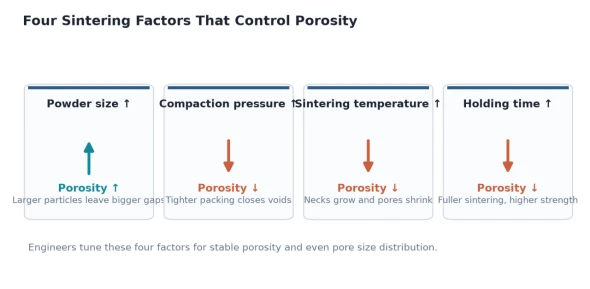
How four sintering factors push porosity up or down
Porosity Grades and Their Working Conditions
We grouped the common porosity windows into four grades. This table helps engineers compare them fast.
| Porosity grade | Mechanical strength | Flow rate | Typical use |
| 28%–32% | High | Low | High-pressure fine filtration, frequent backwash, pressure vessels |
| 33%–38% | Medium-high | Medium | General liquid filtration, chemicals and pharma |
| 39%–45% | Medium | Medium-high | High-flux filtration, environmental water treatment |
| 46%–50% | Low | High | Low-pressure high-flow, gas distribution, fermenter aeration |
Selection Guide by Working Condition
In real projects, engineers should not chase only high porosity or only high strength. They should match the parameters to the case.
| Working condition | Suggested porosity | Reason |
| High pressure, high pressure rating | Low (28%–32%) | Keeps the structure stable and extends service life |
| Frequent backwash, heavy impact load | Low (28%–35%) | Raises fatigue resistance and reduces skeleton cracks |
| General liquid filtration | Medium (33%–38%) | Balances flow rate and filtration accuracy |
| Low pressure, high flow | Medium-high (39%–45%) | Favors flow efficiency and adsorption |
| Gas distribution, fermenter aeration | High (46%–50%) | Needs even gas distribution and low pressure drop |
For low pressure, high flow and normal contaminants, engineers can choose a higher porosity. This favors flow efficiency and adsorption.
For high pressure, frequent backwash, heavy impact load and a high pressure rating, engineers should lower the porosity. This favors structural stability and service life.
Tight porosity control is the core sign of process capability in high-end porous titanium filters.
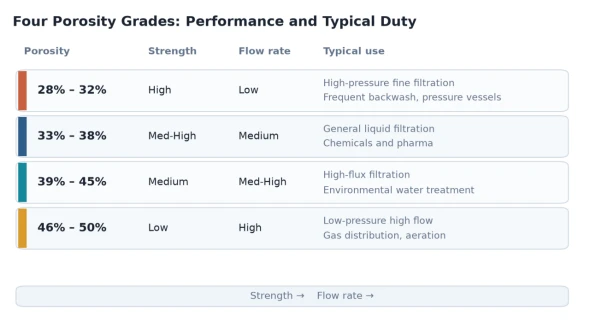
Four porosity grades: performance and typical duty
Cleaning, Regeneration and Common Failure Modes
A titanium filter cartridge can be regenerated many times. This is a big advantage. We use three common cleaning methods.
Backwash is the most common. We push fluid or gas in the reverse direction and flush particles out of the pores. Ultrasonic cleaning suits deep blockage. We place the cartridge in a tank and let the ultrasound shake particles loose. Chemical cleaning removes organics and inorganic scale. An alkaline wash removes oil. An acid wash removes inorganic salts.
Porosity affects both cleaning and service life. A high-porosity material has wide pore paths, so particles flush out easily. But it also clogs deeply more often. A low-porosity material keeps particles out. But once it clogs, cleaning is harder.
Three failure modes are common. Pores collapse under high pressure. Particles embed deeply and block the material for good. Backwash fatigues the skeleton and causes cracks. Engineers who know these modes can design around them early.
Typical Application Scenarios
- Pharma: drug liquid filtration and sterilization. This needs high accuracy and sterilizability, so engineers often pick low porosity and small pore size.
- Environmental water treatment: municipal and industrial water. Flow is high, so engineers pick medium porosity.
- Hydrogen: gas diffusion layers in PEMWE cells and fuel cells. Even gas permeation matters, so engineers often use titanium fiber felt and sintered titanium plate.
- Food and beverage: clarification of wine and drinks. No shedding and easy cleaning matter most.
- Chemicals and petrochemicals: catalyst recovery and corrosive fluid filtration. Corrosion resistance leads here.
- Air aeration: fermenter aeration heads and gas distribution. Uniform pores and low pressure drop matter, so engineers pick high porosity.
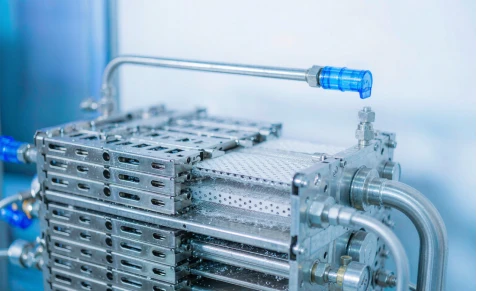
Plates and flow fields of a PEM water electrolyzer (application scene)
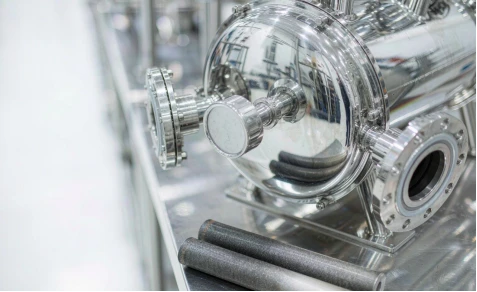
Sanitary filtration system with porous titanium filter rods
FAQ
Does higher porosity always give better filtration?
No. High porosity raises flow rate, but it lowers mechanical strength. Engineers should match it to the case. High-pressure work needs low porosity. Low-pressure high-flow work can use high porosity.
What is the difference between porosity and pore size?
Porosity is how much volume the pores take. Pore size is how big each pore is. They are independent. Two plates with the same porosity but a different pore size perform differently.
What porosity should I choose for high pressure filtration?
We suggest 28%–32%. This grade has high mechanical strength and good resistance to pressure and backwash. It fits pressure vessels and frequent backwash.
How do I measure the porosity of a titanium filter?
We use four common methods. The Archimedes method measures open porosity. MIP measures porosity and pore size distribution. BET measures surface area. Image analysis shows pore shape. Engineers combine them by accuracy needs.
Does porosity affect the service life of a titanium filter cartridge?
Yes. Higher porosity means thinner struts and a shorter fatigue life. So for frequent backwash, engineers should choose lower porosity.
What porosity works best for frequent backwash?
We suggest 28%–35%. This grade has thicker struts, so it survives more backwash cycles and resists skeleton cracks.
Can porosity be customized?
Yes. Engineers tune it through powder size distribution, compaction pressure, sintering temperature and holding time. We can deliver stable porosity and even pore size distribution.
How do I clean a titanium rod filter?
We use three common methods: backwash, ultrasonic cleaning and chemical cleaning. An alkaline wash removes oil. An acid wash removes inorganic salts. Porosity changes how hard cleaning is.